

How to Start an Abacus Coaching Centre with Low Investment
A Practical, Heartfelt Guide for Educator-Entrepreneurs 🌍
Hello, future founders! I’m Ashwani Sharma, Director at Mission Abacus Private Limited in Jaipur. Over chai with countless passionate teachers, I’ve seen a familiar spark—the dream of having their own space to shape young minds. But that dream often bumps into a big, scary word: Investment.
What if I told you that the most important investment isn’t money, but your passion and strategy? Today, we’re going to break down exactly how to start an abacus coaching centre with low investment. This is a lean, smart, and deeply rewarding path. It’s about starting where you are, not where you think you should be. 🧮

Let’s replace fear with a clear, actionable plan. Your centre can begin not with a lavish classroom, but with a powerful idea and the right first steps.
Table of Contents
- The Lean Mindset: Your Greatest Asset
- Phase 1: The Foundation (Cost: Mostly Your Time)
- Invest in Your Own Expertise First
- Define Your Unique “Why” and Model
- Choose Your Launch Platform: Home, Hybrid, or Online
- Phase 2: The Minimalist Setup (Controlled Costs)
- The “Good Enough” Classroom
- Essential Teaching Kits, Not Inventory
- Your Digital Office: Free & Low-Cost Tools
- Phase 3: The Zero-Cost Marketing Engine
- Your Network is Your Net Worth
- Master the Free Demonstration Workshop
- Become a Community Resource, Not an Ad
- Phase 4: Launching Your First “Beta Batch”
- Pricing for Value, Not Desperation
- The Critical 10-Student Goal
- Deliver Phenomenal, Shareable Results
- Scaling Smart: Reinvesting Your First Profits
- Realistic Timeline & Expectations
- FAQs for the Bootstrapping Educator
1. The Lean Mindset: Your Greatest Asset
Before spending a single rupee, dollar, or pound, adopt this mindset: Start with what you need, not what you want. A low-investment start isn’t about being cheap. It’s about being strategic and resourceful.
Your initial goal isn’t to have a fancy signboard. It’s to prove your concept, deliver transformative results to a small group, and generate cash flow. That cash flow then funds your growth. This approach minimizes risk and builds a real, organic business.
2. Phase 1: The Foundation (Cost: Mostly Your Time)
This phase costs little money but requires your full focus.
Invest in Your Own Expertise First
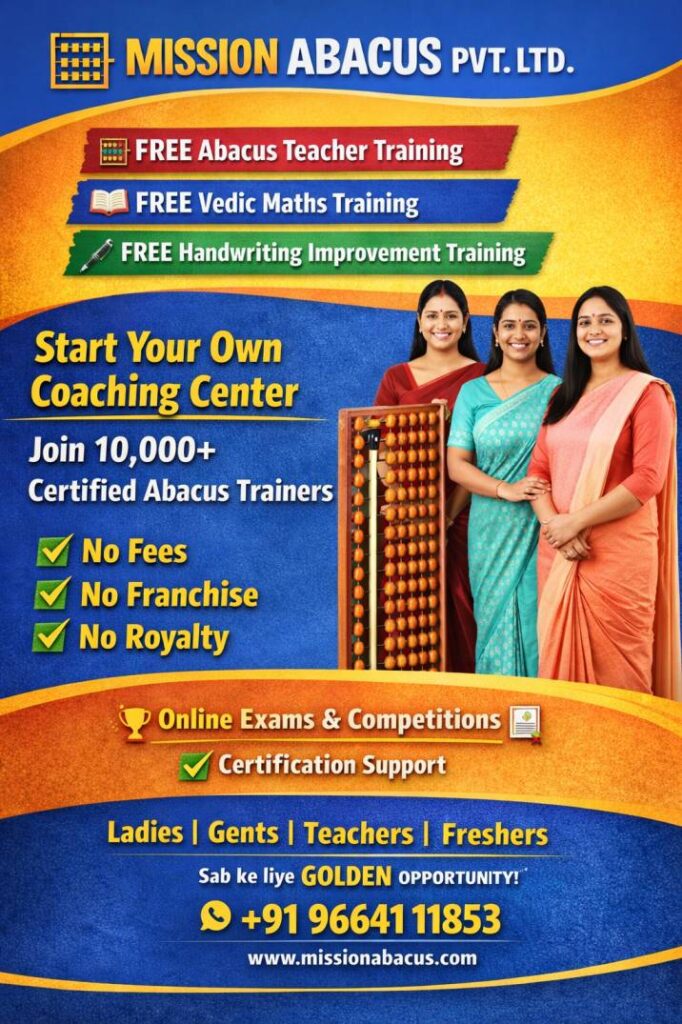
You cannot build a house on sand. If you’re not already a certified abacus teacher, this is your first and most crucial investment. A strong pedagogical foundation is non-negotiable. We offer a FREE Abacus Teacher Training demo precisely for this reason—to give you a risk-free start in mastering the craft. This knowledge is your core product.
Define Your Unique “Why” and Model
Why should a parent choose you? Is it your focus on math anxiety? Your innovative use of technology? Get clear on this. Then, decide your model:
- Home-Based Centre: Lowest overhead. Use a clean, well-lit room in your house.
- Hybrid Tutor: Teach at students’ homes or in community spaces (library rooms are often free/cheap).
- Online-First Centre: Zero rental cost. Maximum geographic reach from day one.
Choose Your Launch Platform: Home, Hybrid, or Online
For a truly low investment start, I recommend beginning online or from a home classroom. It removes the single biggest monthly expense: commercial rent. You can always add a physical location later, funded by your profits.
3. Phase 2: The Minimalist Setup (Controlled Costs)
Now, spend on only the absolute essentials.
The “Good Enough” Classroom
A clean, quiet, and well-lit space is all you need. A plain wall as a backdrop. A small whiteboard or a tablet for display. A few chairs and tables. That’s it. No paintings, no fancy furniture. The magic is in your teaching, not the décor.
Essential Teaching Kits, Not Inventory
Do not stockpile. Buy student kits (abacus, books, bag) only as students enroll. Ask for a material fee upfront to cover this cost. Your own teaching toolkit—a demonstration abacus, some stationery—is a one-time, minimal cost.
Your Digital Office: Free & Low-Cost Tools
- Communication: WhatsApp Business (free) and a professional Gmail address.
- Scheduling: Use Google Calendar.
- Payments: Use simple bank transfer links or UPI/PayPal.
- Presence: A simple Facebook Page or Instagram profile is your “website.”
- Teaching System: This is your operational backbone. Partnering with an established system like ours at Mission Abacus gives you a ready-made curriculum, certification, and the All-in-One Abacus Learning System—access to the Abacus Level Exam Platform and the Abacus Competition Platform. This saves you years and thousands in developing your own.
4. Phase 3: The Zero-Cost Marketing Engine
You don’t need a marketing budget. You need hustle and authenticity.
Your Network is Your Net Worth
Tell everyone you know—family, friends, former colleagues—that you are starting. Be specific: “I’m launching a small, focused batch to build math confidence in kids. Do you know any family who might be interested in a free demo session?” Personal referrals are gold.
Master the Free Demonstration Workshop
This is your single most powerful marketing tool. Host a 60-minute “Focus & Fun Math” workshop at a local library, community hall, or online. Let kids experience a win. Let parents see your teaching style and the benefits of abacus for kids](https://missionabacus.com/what-is-abacus-benefits-of-abacus-for-kids/) firsthand. Collect emails for follow-up.
Become a Community Resource, Not an Ad
Join local parent groups on Facebook. Don’t post ads. Answer questions. “Struggling with your child’s homework focus? Here’s one simple technique…” Provide genuine value. People will seek out the helpful expert.
5. Phase 4: Launching Your First “Beta Batch”
Your goal is not 100 students. It’s 10. Your first 10 students are your partners.
Pricing for Value, Not Desperation
Do not underprice dramatically. It devalues your service and sets a bad precedent. Charge a fair rate that reflects the transformation you offer. You can offer “Founding Student” benefits like a free practice kit or extra progress sessions instead of a discount.
The Critical 10-Student Goal
With 10 students, you have a viable micro-business. You can cover your minimal costs and pay yourself a modest salary. This is the sustainability milestone. Focus all your energy on finding and delighting these first ten families.
Deliver Phenomenal, Shareable Results
Go above and beyond for this batch. Communicate weekly. Celebrate every small win. When a child passes their first level exam or shows improved concentration, document it (with permission). A happy parent’s testimonial or a short video is marketing you cannot buy.
Students who practice regularly, appear for level exams, and participate in competitions show faster improvement in speed, accuracy, and confidence. Use tools like the Abacus Audio Practice to ensure their home practice is effective, leading to these visible results faster.
6. Scaling Smart: Reinvesting Your First Profits
Once your first batch is running smoothly and paying you, you have cash flow. Now, reinvest strategically:
- Professional Materials: Get better-quality certificates or a branded whiteboard.
- Digital Marketing: Put $50 into a targeted Facebook ad to parents in your suburb.
- Your Own Training: Take an advanced course.
- Savings for Rent: Start saving for a small, shared commercial space for your next batch.
Grow only as fast as your quality can be maintained. For a deeper understanding of structuring the student journey as you grow, our guide on Abacus for Kids: Age, Levels & Learning Process is invaluable.
7. Realistic Timeline & Expectations
- Month 1-2: Training & Planning (Phase 1). Minimal cost.
- Month 3: Setup & First Demo Workshops (Phases 2 & 3). Small costs for kits and maybe a library room fee.
- Month 4: Launch your first “Beta Batch” of 5-10 students. You are now generating revenue.
- Month 6: You should be breaking even or making a small profit. Start planning Batch 2.
- Year 1: Aim to have 2-3 batches running (20-30 total students). You now have a proven, sustainable business to grow from.
8. FAQs for the Bootstrapping Educator
Q1: What is a realistic total “low investment” figure to start?
A: You can genuinely start for the equivalent of $200-$500. This covers your teaching kit, initial student materials for your first 3-5 students, and minor digital/printing costs. The key is to avoid fixed monthly overheads like rent at the very beginning.
Q2: Is it better to start independently or take a low-cost franchise?
A: A low-cost affiliation or partnership (like with Mission Abacus) is often smarter for beginners. You get a proven curriculum, brand support, exam systems, and marketing templates. This saves you immense time and the cost of trial-and-error, allowing you to focus on teaching.
Q3: How do I handle legal registrations and taxes on a low budget?
A: Start as a sole proprietor/sole trader. It’s the simplest structure. Keep clear records of all income and expenses. Once you’re consistently profitable (after 6-12 months), consult a small accountant to formalize. Don’t let complex paperwork paralyze your start.
Q4: What if I’m introverted and bad at “selling”?
A: You’re not selling; you’re sharing your passion. Let your demo workshop do the talking. Your genuine care and expertise will attract parents who value substance over slick salesmanship. Focus on the transformation, not the transaction.
Q5: Can I run this alongside my current teaching job?
A: Absolutely! This is the perfect way to start. Run your first batch on weekends or weekday evenings. This keeps financial pressure low and allows you to test the waters without quitting your day job.
Q6: What’s the biggest mistake to avoid in a low-investment start?
A: Trying to look bigger than you are by overspending on logos, office furniture, or fancy websites before you have a single student. Your credibility comes from your teaching results and parent word-of-mouth, not a glossy brochure. Stay lean until the students are paying for the growth.
Starting an abacus coaching centre is a journey of passion meeting pragmatism. How to start an abacus coaching centre with low investment is about leveraging your greatest resources—your knowledge, your network, and your commitment—before you worry about capital.
From my own journey in Jaipur, I can tell you that the centre built slowly, with care for each student, becomes the strongest. It’s built on a foundation of real results, not debt.
Take that first, smart step. The world needs more spaces where children discover the power of their own minds. You can be the one to create it.
Warmly,
Ashwani Sharma
Director, Mission Abacus Private Limited
Jaipur, India 🇮🇳