Your Calling: A Heartfelt Guide on How to Become a Certified Abacus Teacher 🧮
Welcome, future mentors!
I’m Ashwani Sharma, and from my desk at Mission Abacus Private Limited in Jaipur, I’ve had the privilege of guiding hundreds of wonderful individuals just like you. Many are passionate parents, dedicated school teachers, or simply those who love working with children and want to make a tangible difference.
If you’re reading this, you’re likely asking a beautiful question: “How do I become a certified abacus teacher?” Let me tell you, this isn’t just about adding a certificate to your resume. It’s about answering a calling to shape young minds in the most foundational way. This guide is my honest, step-by-step map for your journey. Let’s walk this path together. ✨
Table of Contents
- Why Certification Matters More Than You Think
- The Mindset of a Great Abacus Teacher
- Step 1: Finding the Right Training Program
- Step 2: Diving Deep into the Learning Phase
- Step 3: The Certification & Assessment Process
- Step 4: Your Toolkit for Success (Beyond the Beads)
- Step 5: Launching Your Teaching Journey
- Your Questions Answered (FAQs)
Why Certification Matters More Than You Think
Let’s start with the “why.” Anyone can learn to move beads. But to teach? That’s an art and a science.
A proper certification does three crucial things. First, it gives you structured knowledge—not just how to calculate, but why the methods work, and the psychology behind teaching them. Second, it gives parents confidence. That certificate is a promise that you’ve been trained to handle their child’s learning journey responsibly. Third, and most importantly, it gives you confidence. You’ll know you’re not just winging it; you’re applying proven, effective pedagogy.
It transforms you from a hobbyist into a professional educator. That’s the foundation you need if you dream of making this a meaningful part of your life’s work.
The Mindset of a Great Abacus Teacher
Before we get to the “how,” let’s talk about the “who.” The best abacus teachers I know share a few beautiful traits.
Patience is your superpower. You will see the same concept misunderstood ten different ways. Your calm repetition is what builds a child’s confidence.
You must be a celebrator. The joy isn’t just in the child who cracks big numbers. It’s in the one who finally, finally understands how to make a friend of the number 10. You celebrate every single step.
You are a bridge builder. You build a bridge from fear to fun, from confusion to clarity. If you’ve ever wanted to directly see how abacus reduces maths fear, becoming the teacher who facilitates that is the most rewarding experience.
This mindset is your true certification. The paper just formalizes it.
Step 1: Finding the Right Training Program
This is your most important decision. Not all training programs are created equal. Here’s what to look for:
A. Comprehensive Curriculum: It must cover more than calculation. Look for modules on child psychology, classroom management for different age groups, lesson planning, and parent communication. A program that also integrates modern tools like abacus audio practice is teaching you for today’s world.
B. Experienced Mentors: Who is training you? Look for institutes with a track record. At Mission Abacus Private Limited, our trainers are themselves veteran teachers who have walked the path you’re starting on. They share real classroom stories, not just theory.
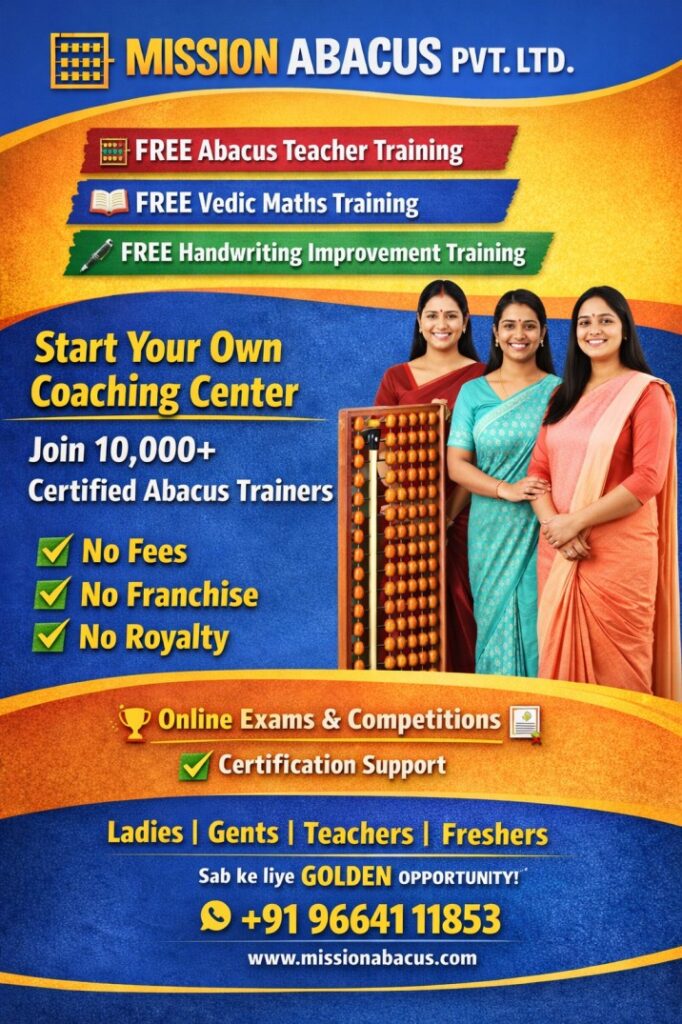
C. Practical & Flexible: Is it all lecture, or do you get to practice-teach? Is it online, offline, or hybrid? Choose a format that fits your life. A fantastic, no-pressure way to start is by exploring our FREE Abacus Teacher Training introductory session. It lets you experience the methodology and see if it resonates with your spirit.
Step 2: Diving Deep into the Learning Phase
Once you enroll, immerse yourself. This is your time to be a student again.
Master the Tool First: Don’t rush. Become fluent with the physical abacus. Feel the beads. Understand the logic of each formula in your bones. This foundational comfort is non-negotiable.
Learn to Visualize: A true teacher must master mental math. You need to experience the journey from physical beads to the mind’s eye yourself. This is where you start to appreciate the powerful mental calculation techniques you’ll be passing on.
Study the Pedagogy: Pay close attention to how concepts are introduced. Why do we start with small friend numbers? How do we correct a child’s finger movement without discouraging them? This is the gold of your training.
Step 3: The Certification & Assessment Process
A credible certification isn’t just given; it’s earned. Be prepared for a fair and thorough assessment.
Theoretical Knowledge: You’ll likely be tested on the concepts, the history of the abacus, and your understanding of the teaching methodology. This ensures you know your “why.”
Practical Teaching Exam: This is the heart of it. You will be asked to teach a concept—perhaps to your trainer or a small group. They will assess your clarity, your patience, your ability to explain, and your rapport. It’s not about being perfect; it’s about showing you can connect and guide.
Final Certification: Upon passing, you’ll receive your certificate. This credential is your key. It allows you to confidently tell parents, “I am a trained professional.” It also often grants you access to the institute’s ongoing resources and community.

Step 4: Your Toolkit for Success (Beyond the Beads)
Being certified is the start. To be a successful certified teacher, you need a full toolkit.
A. Your Teaching Kit: This includes quality demonstration abacuses, student workbooks, flashcards, and other engaging aids. A good training program will guide you on sourcing these.
B. The Ecosystem Advantage: The best teachers don’t work in a vacuum. They are part of a system that supports student growth. Remember: Students who practice regularly, appear for level exams, and participate in competitions show faster improvement in speed, accuracy, and confidence.
Familiarize yourself with platforms that support this. For instance, AbacusExam.com provides a structured platform for level exams, and AbacusShiksha.com hosts motivating competitions. Knowing how to use this All-in-One Abacus Learning System makes you a more effective teacher.
C. Continuous Learning: Your first certification is a license to learn. Attend refresher workshops, learn new brain games, and stay curious. Great teachers are always students.
Step 5: Launching Your Teaching Journey
Your certificate is in hand. Now what? Here’s how to take your first steps into the classroom.
Start Small & Safe: Begin with a pilot batch of 3-5 students. They could be children of friends or family. This low-pressure environment lets you refine your skills, build confidence, and create your first success stories.
Create a Magical Space: Whether it’s a corner of your home or a dedicated room, make it welcoming. Have displays, keep it organized. For ideas on setting up a learning-friendly environment, you can look at guides on how to start an abacus coaching centre.
Communicate with Heart: Your first parent-teacher meetings are crucial. Share the journey, not just the results. Explain the process, the importance of practice (including tools like AbacusWala.com for home reinforcement), and celebrate small wins together. This builds immense trust.
Your Questions Answered (FAQs)
1. What are the basic qualifications needed to enroll in a certification course?
Typically, a minimum of a high school diploma (12th grade) and a passion for teaching children are the primary requirements. A background in education or mathematics is helpful but not mandatory. The right attitude matters most.
2. How long does it take to become a certified abacus teacher?
A comprehensive certification course can range from 2 to 4 months, depending on the intensity and schedule (weekends vs. weekdays). This includes learning, practice, and the final assessment.
3. Can I do this certification online?
Yes, many reputable institutes, including ours, offer high-quality online certification programs with live interactive sessions, recorded modules, and virtual practice teaching. It makes the training accessible no matter where you live.
4. What is the career scope after certification?
Immense! You can start your own home tuition or coaching centre, join an existing abacus school, collaborate with mainstream schools as a specialized instructor, or even conduct online classes globally. It’s a skill in growing demand.
5. Is there a good age to start this as a career?
Not at all! We have certified teachers who are recent graduates, mid-career professionals looking for a change, and even retired individuals who want to give back. If you have the patience and love for children, your age is an asset, not a barrier.
6. How much can I expect to earn as a certified abacus teacher?
Earnings vary based on location, whether you are employed or independent, and your class size. Many independent teachers in India start earning a respectable supplementary income that can grow into a full-fledged profession. Internationally, the fees and potential can be significantly higher.
Walking the path to become a certified abacus teacher is one of the most fulfilling decisions you can make. You are choosing to be the person who turns confusion into confidence, who replaces “I can’t” with “I did it!”
I have seen this journey change lives—both the students’ and the teachers’. It brings a unique kind of joy that comes from empowering a young mind.
So, if your heart is leaning towards this, take that first step. Seek knowledge. Get trained. Earn your credential with pride. A classroom full of bright, eager minds is waiting for a guide like you.
The world needs more teachers who teach from the heart. Will you be one? 💫
With warm encouragement for your journey,
Ashwani Sharma